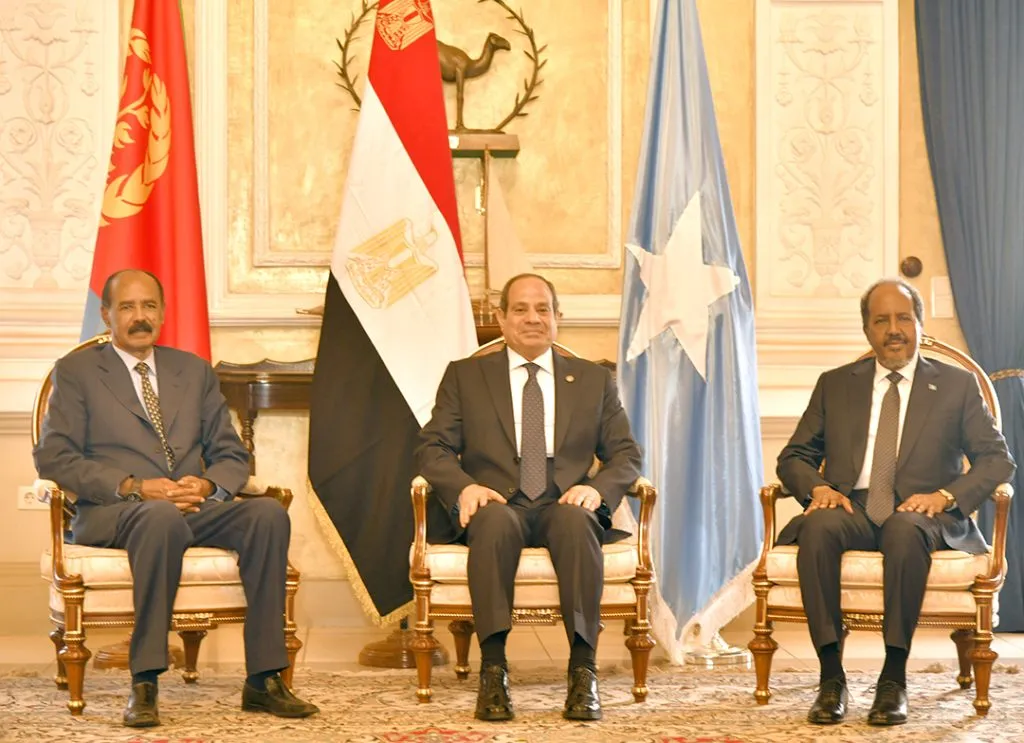
This evolving alliance reflects shifts in the region’s geopolitics, following a breakdown in relations between Eritrea and Ethiopia, particularly after the Pretoria Agreement in 2022. Eritrea, feeling sidelined during the peace negotiations between Ethiopia and the Tigray region (where it was a key player in the conflict), has been maneuvering to build a new alliance with Egypt and Somalia. Egypt’s involvement is particularly notable, as it continues to oppose Ethiopia’s Grand Ethiopian Renaissance Dam (GERD) project on the Nile, which has been a point of contention for years.
The emerging alliance between Eritrea, Egypt, and Somalia, now formalized at this summit, appears to counterbalance Ethiopia’s regional influence. This follows the fallout between Ethiopia and Somalia over Ethiopia’s memorandum of understanding (MoU) with Somaliland in early 2024, which granted Ethiopia access to a coastal area in Somaliland, a self-declared independent region that Somalia still considers part of its territory. This MoU heightened tensions as Somalia views it as a violation of its sovereignty, further straining Ethiopia-Somalia relations.
In this context, Egypt has found an opening to strengthen its ties with Somalia, which it formalized with a military pact in August 2024. Eritrea, seeking to distance itself from Ethiopia, appears to have gravitated towards this new alliance, with a focus on deepening cooperation with Somalia to counter internal and external threats, especially terrorism, and ensuring the sovereignty and territorial integrity of the region.
The broader implications of this summit are significant. First, it reflects a deepening rift between Eritrea and Ethiopia, underscored by the suspension of Ethiopian Airlines flights to Asmara, the freezing of Ethiopian bank accounts in Eritrea, and the disruption of communications between the two countries. This signals that, despite official denials, the relationship between Addis Ababa and Asmara is deteriorating.
Second, Somalia’s internal dynamics are likely to be affected by this alliance, particularly given the resistance from regional states to the federal government’s ties with Egypt and the potential for Egyptian military presence in Somalia. This could exacerbate existing tensions within Somalia’s federal structure, especially in light of Mogadishu’s ongoing efforts to assert control over its territory, including Somaliland, which seeks international recognition as an independent state.
Overall, the tripartite summit suggests a reshaping of alliances and power balances in the Horn of Africa, with potential consequences for regional stability, security, and development. This realignment positions Egypt, Eritrea, and Somalia as a counterforce to Ethiopia, which is increasingly isolated amid these diplomatic developments.
Telegaraf news