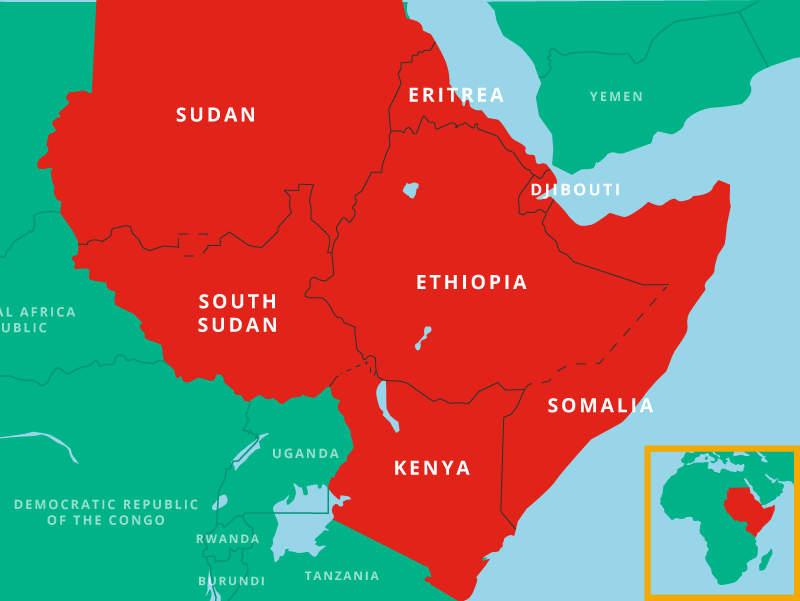
Mogadishu,Somalia The Greater Horn of Africa (Ethiopia, Sudan, Eritrea, Djibouti, South Sudan, and Somalia) is one of the most complex security zones in the world, has the largest number of displaced people, hosts many nonstate actors, and has intra- and threats of interstate conflicts that could threaten global stability. With nearly 64 million people needing humanitarian and protection assistance across the Horn of Africa, the region accounts for close to 22 percent of the global humanitarian caseload in 2024. Sudan and Ethiopia alone are two of the world’s five largest humanitarian crises. The Sudan crisis accounts for almost 40 percent (25 million people) of the regional total, followed by Ethiopia (21 million), South Sudan (9 million) and Somalia (8.3 million) (OCHA).
Ethiopia, Sudan, and Somalia are the epicenters of the crisis as three failed states whose internal and external policies are guided by nonstate state actors rather than by their respective “governments.”
Each country in the Horn has been experiencing some measure of political conflict and/or instability for decades. The conflict and violence have been compounded by the effects of drought, and, more than any other region in the world, disease pandemics. These factors have forced populations to seek help from international humanitarian organizations, frontline local actors, Europe, and America.
Ethiopia
The government state power in Ethiopia has been challenged by three major nonstate actors: the TPLF in Tigray, the OLF in Oromia, and the Amhara Fano. In all three regions, there is a civil war directed against each other and the government of PM Abiy. Abiy has no or little control over this vast country. He thrives by printing money and selling the country’s assets to any foreign bidder. Ethiopia has become a country where civil war has been raging for over six years. The conflict has caused widespread devastation, displacing millions of people and triggering the most severe humanitarian crisis in the world after Gaza. Many countries think that PM Abiy has a calculated national policy. In reality, Abiy is driven by instinct and a sense of insecurity which prompts him to do anything that will prolong his life in the capital city. The country is broken and on its knees, surrendering to the will of the IMF for loans under strict conditions and the UAE for cash and armaments. PM Abiy creates distractions to mobilize national sympathy by creating crises with neighboring countries and a false narrative that Ethiopia is being invaded. Most recently he came up with an unimplementable arrangement to gain access to the sea through Somaliland in an attempt to galvanize support from Ethiopians who live with the regret of losing Eritrea. He knows this will not and cannot happen, but he feels he needs an international crisis of this sort to justify his position as a leader.
Al Shabab and Ethiopia
The activities of Al Shabab are on the rise in some parts of Ethiopia. It has exploited Ethiopia’s internal turmoil to cross the border from neighboring Somalia in unprecedented attacks (Faruk). Ethiopia’s recent misstep in Somaliland has only made this danger worse. Somalia is furious that a Memorandum of Understanding (MoU) was signed between PM Abiy and the leadership of Somaliland. The Somali government has warned the international community that this MoU violates the rights of a sovereign state and might trigger war between the two countries. Former National Security Adviser Abdisaid Muse Ali of the government of Somalia has even suggested that the Somali government should allow Al-Shabaab to take over the government of Somalia if it cannot counter the repeated challenges to Somalia’s sovereignty by PM Abiy Ahmed (“Somali Government”).
In Kenya’s northeast, al-Shabaab recruits many young people through various techniques, including capitalizing on their discontent with historical socio-political marginalization. “The intelligence agencies of Ethiopia and Kenya have asserted that the Oromo Liberation Army (OLA), referred to by Ethiopian authorities as ‘Shene,’ has established direct connections with the al-Shabaab militants based in Somalia. They accuse these groups of collaborating to ‘undermine security in the region’.” (“Ethiopia, Kenya Unite”) Attacks by Al Shabaab occur at alarming regularity in Kenya despite the efforts of security forces. In August, an attack occurred in Marsabit County on the border with Ethiopia — the first since 2020 (“What’s Next”). The Somalia government has another potent instrument to destabilize Ethiopia. The Western Somalia Liberation Movement (WSLF), later reconstituted as the Ogaden National Liberation Movement (ONLF), was a branch of the state power of Somalia under Siad Barre that ignited the war between Ethiopia and Somalia in 1978. Somalia, at first supported by the Soviet Union, eventually occupied most of what is known as the Ogaden plus territories near Harar and Dire Dawa. This dire situation was Ethiopia’s greatest test since the Italian invasion of the Second World War. I was then the deputy foreign minister and the focal point for the diplomatic effort which turned into a major confrontation between the Soviet Union and the USA. Owing to the determination of Ethiopian patriots, the Somalis were pushed out, but the danger has never disappeared. Over the years since that war, ONLF insurgents have periodically attacked the national army with secession as its goal (See my books Red Tears and Kihdet Be Dem Meret).
Somaliland
Somaliland unilaterally declared independence from Somalia and has been a de facto state since 1991. Though Somaliland has built functioning government institutions, it has not and cannot legally be recognized by the UN or AU under international law. It is still considered as part of Somalia unless there is a binding mutual agreement between the two, as was the case in Eritrea. The region has established its government and institutions, but it remains unrecognized by the international community.
As mentioned previously, on 2 January 2024, Muse Bihi Abdi, the president of Somaliland and Ethiopian Prime Minister Abiy Ahmed signed a memorandum of understanding (MoU) in Addis Ababa, Ethiopia’s capital. The deal grants Ethiopian naval forces access to 20 kilometers of Somaliland’s coastline in the Gulf of Aden for 50 years. Prime Minister Abiy Ahmed, in turn, agreed to consider Somaliland’s recognition. Based on the agreement, Somaliland also obtains a stake in Ethiopian Airlines.
Somalia
Tensions between Mogadishu and Addis Ababa escalated after the signing of this MoU that provides sea access to Ethiopia in exchange for its recognition of Somaliland statehood. Al Shabaab used the MoU as a strategy to recruit new members, calling on the Somali people to defend and protect their land from Ethiopia and other foreigners. The MoU also caused the Somali government to reject the use of Ethiopian troops operating in Somalia as part of the AU force fighting Al-Shabaab. In June the national security advisor stated unequivocally: “As long as Ethiopia persists in violahng our sovereignty, territorial integrity, and political independence, we cannot and will not consider it an ally in advancing peace and security in the region” (Somalia Declares).
Egypt has announced that it will dispatch 10,000 troops to Somalia to replace Ethiopian troops. This is more men than Ethiopia originally had, and of course is a major escalation to the security environment in the Horn of Africa. On August 29, two Egyptian military planes carrying weapons and ammunition landed at Mogadishu airport as a part of Egypt’s planned deployment in the peacekeeping mission, though it was well known that Egypt’s intentions went much further than that.
Tensions between Egypt and Ethiopia are at unprecedented levels over the Grand Ethiopian Renaissance Dam (GERD) on the Nile River. Since construction began in 2011, Egypt has viewed the dam as a direct threat to its water supply. Despite multiple rounds of negotiations, including a 2019 U.S.-brokered effort, the parties have failed to reach a lasting agreement. The close relationship with Somalia now gives Egypt the strategic advantage for any possible intervention in Ethiopia.
Tensions ratcheted up to an even higher notch in early September when Ethiopian troops in Somalia seized key airports in the Gedo region, in order prevent Egyptian troops from landing and replacing Ethiopian forces as Somalia demanded. These airports are the only way to reach towns in that region since the main roads are controlled by Al Shabaab. (Ethiopia Seizes)
Somalia has rejected all negotiations with either Ethiopia or Somaliland on the MoU issue saying, “There is no space for mediation unless Ethiopia retracts its illegal MoU and reaffirms Somalia’s sovereignty and territorial integrity.” (Somalia Rejects)
Türkiye, a key Somali partner, has also been trying to mediate the dispute with two rounds of discussions in Ankara. But the tension was so great between the two countries that the foreign ministers would not even hold direct talks–Türkiye’s foreign minister shuttled between them. Abdi Aynte, a former Somali minister of planning and international cooperation who was involved in the negotiations warned that unless Ethiopia withdraws the MoU, nothing would come of these talks. The only thing they agreed upon was to reconvene on September 17. (Hassan)
In Somalia Al-Shabaab continues to control large swathes of rural Somalia, carrying out regular attacks against government forces, civilians, and international targets. The group’s insurgency poses a major threat to Somalia’s stability and development. Though Somalia has come a long way from troubled decades it seems that instability will get worse with this current crisis.
Djibouti
Djibouti, a strategically located country at the entrance to the Red Sea, is home to several foreign military installations. The country has emerged as a key player in the Horn of Africa, but it is also facing security challenges. Whatever happens in Somalia and Ethiopia directly affects Djibouti. Djibouti’s strategic location makes it a vital country that cannot have international relations on its own terms alone. It must conform to the interests of all those who use the Red Sea. Instability in Djibouti or any changes in foreign policy that could affect peaceful and unconditional passage over the Red Sea will have serious consequences.
Ethiopia currently depends on Djibouti ports for all its imports and exports. This has always been a major source of revenue for Djibouti. If a new arrangement with Somaliland were to be implemented Djibouti’s interest would be seriously affected. To counter Abiy’s arrangement with Somaliland, Djibouti’s Foreign Minister Mahmoud Ali Youssouf has proposed granting Ethiopia a pathway to the Red Sea with “100 percent management of a port in the new corridor that has already been built.” The port in Tadjoura is just 100 km from the Ethiopian border. This practical solution would not only help maintain the financial benefit Djibouti receives from the transport of Ethiopian goods but, as Youssouf stressed, would defuse the crisis and maintain regional stability. (Djibouti Offers)
Eritrea
Eritrea remains a highly militarized state with a troubled past. Its relationship with Ethiopia is complex and fraught with tension mainly due to successive Ethiopian governments refusing to accept International Court of Justice (ICJ) decisions over the disputed border issues. The two countries fought a border war in 1998-2000, and despite the decision by the Permanent Court of Arbitration in the Hague to award the territory to Eritrea, the Ethiopian government refused to peacefully hand over this small patch of land. Even after the much-publicized peace accord in which Prime Minister Abiy agreed to abide by the Court’s decision and give the land to Eritrea, nothing happened. The accord won Abiy the Nobel Peace Prize in 2019, but it was not until the Tigray war that this land was forcefully taken by Eritrea.
Further straining relations in the region, Ethiopia has accused Eritrea of backing the Amhara rebel militia, Fano. Perhaps in retaliation, Ethiopia hosted a gathering of the Eritrean opposition group, Birged N’Hamedu (the N’Hamedu Brigade) which takes its name from a famous fighting unit in the war for independence from Ethiopia. This youth-based group in the diaspora has taken a stand against the dominant ruling party, the People’s Front for Democracy and Justice (PFDJ), and has met publicly in Addis Ababa with Ethiopia’s blessing several times (Omer). They have also held meetings in Adigrat, a city in the Tigray region of Ethiopia and apparently are supported in particular by the Tigrayan leadership who suffered at the hands of the Eritrean military in their recent war of secession.
Within the past year, the N’Hamedu Brigade has been involved in several protests in Canada, Europe, and Israel at events that support the Eritrean government, like Eritrean Independence Day celebrations. Often these protests have led to skirmishes and injuries. In a newspaper interview the global head of the N’hamedu Brigade, Kibreab Kiros, confirmed that this group is currently engaging in various activities worldwide “with the ultimate goal of removing the oppressive Eritrean regime and ensuring the safety of its people and the country” (Ethiopia News).
According to one leader at the Addis conference on May 28, “Our enemy is in Eritrea. Therefore, our activities here, in Europe or America will not bring about change inside Eritrea. Hence, we have decided to consolidate all our resources to conduct an [armed] struggle from nearby. Our objective is only one: to topple the regime” (Plaut).
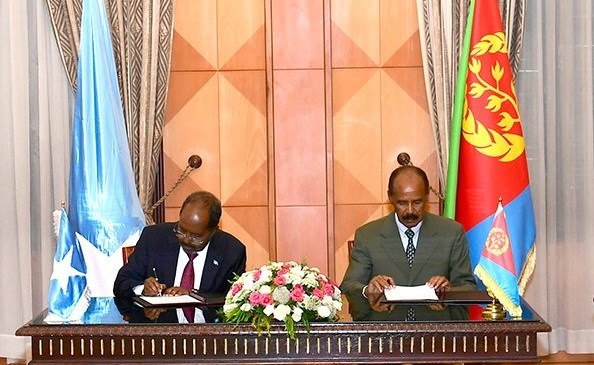
Even before the MoU between Ethiopia and Somaliland, Eritrea supported the government of Somalia by helping rebuild its armed forces. The president of Somalia, Hassan Sheikh Mohamud, has visited Eritrea two times in the last six months, as part of a longstanding military cooperation between Somalia and Eritrea, which included the latter providing training and support to the Somali National Army and Airforce since 2018 (Eritrea Instrumental).
Egypt’s Foreign Minister Badr Abdelatty met with his counterparts from Somalia and Eritrea, Ahmed Mu’alim Fiqi and Osman Saleh respectively, in a trilateral meeting on the sidelines of the 79th session of the United Nations General Assembly. The Egyptian government stated that – Egypt’s Foreign Minister Badr Abdelaoy met with his counterparts from Somalia and Eritrea, in a trilateral meehng on the sidelines of the 79th session of the United Nahons General Assembly.
The meeting underscored the three countries’ high-level coordination and political will to achieve shared goals and interests. The ministers also emphasized the need to maintain stability in the region and respect Somalia’s sovereignty, unity, and territorial integrity. They agreed to continue close coordination and cooperation on issues of mutual interest in the coming period, building upon the strong bonds of brotherhood and friendship between their people and governments, as well as their shared perspectives and positions (Egypt Daily). This trilateral meeting comes after Egypt’s Foreign Minister Abdelatty and the Head of the General Intelligence Service, Abbas Kamel, visited Eritrea in September and met with President Afwerki.
Adding to the shifting relationships in the Horn, the leader of the Tigray People’s Liberation Front, Debretsion Gebremichael, revealed that the TPLF has been engaged for months in talks with the leaders of Eritrea. The first meeting took place in Dubai, United Arab Emirates. (Tigray Leader). This development will undoubtedly have implications for the war Abiy has declared on the Amhara region, with a possible shift of Eritrea’s policy towards the government of Abiy since this meeting was held with his approval. The discussion centered around the presence of Eritrean opposition forces in Tigray. Could there be compromises made here? This could be concerning to the Amhara resistance.
Sudan
The situation in Sudan is dominated by the civil war. The International Rescue Committee (IRC) report clarifies how the war has devastated the nation. “Sept 2024 marks one year and six months since fighting broke out between rival factions of Sudan’s security force, the Sudanese Armed Forces (SAF) and the Rapid Support Forces (RSF), engulfing Sudan in conflict. The conflict has directly killed at least 14,700 people and injured almost 30,000 more. Due to extensive fighting, at least one-third of the population is displaced, and nearly half the population–25 million people–need humanitarian assistance. In Darfur, mass killings and displacement have led to reports of ethnic violence.
Sudan’s conflict has had a catastrophic impact on almost every aspect of day-to-day life in the country. The scale and extent of Sudan’s deteriorating humanitarian crisis propelled it to the top of IRC’s 2024 Emergency Watchlist” (Sudan Crisis Report).
The displacement and damage to infrastructure coupled with drought have resulted in famine with 26 million at risk (World Food Program). The indifference of the leaders of the warring factions is compounding the problem, reminiscent of the Ethiopian famine of 1984-5 when I was head of the Relief and Rehabilitation Commission and our leaders pretended the starving did not exist. As if this were not enough tragedy, millions of displaced people in Sudan are now also grappling with worsening conditions due to heavy seasonal rains and flooding.
Prime Minister Abiy is concerned that the RSF’s growing presence on its border could create opportunities for cooperation between the RSF and Amhara militias. Though the Ethiopia government together with UAE supported the RSF rebels, he had a meeting with General Abdel Fattah al-Burhan in Port Sudan to discuss the matter. However, there is no peaceful resolution in sight. Sudan is broken and it will take years to bring back a unified nation. It might even never happen. The stakeholders are too many and the war is out of the control of the two leaders. As long as there are opportunistic players and a supply of weapons, the war will continue. The weaponry is not about to run out as greedy arms dealers and countries with an interest in the conflict make guns available. Despite the mandatory UN Security Council embargo in place for two decades, “recently manufactured weapons and military equipment from countries such as Russia, China, Türkiye, and the United Arab Emirates (UAE) are being imported in large quantities into Sudan and then diverted into Darfur. Weapons and ammunition are also being smuggled into the country directly through Darfur” (Amnesty).
South Sudan
As a result of the civil war in its northern neighbor, South Sudan is facing an economic crisis that could also cause political turmoil to a country already suffering from ethnic conflicts and food insecurity. Refugees are pouring over the border, worsening a previously existing food crisis, but equally as important, the war has disrupted its oil exports that travel on pipelines to Port Sudan on the Red Sea. Oil is the government’s main source of revenue and without Sudan’s infrastructure, it cannot be delivered. In addition, South Sudan has millions of internally displaced refugees in neighboring countries from its own, earlier civil war, and continuing ethnic unrest. Save the Children said this September almost 794,000 refugees and South Sudanese returnees, including an estimated 476,000 children have fled to South Sudan since conflict escalated in April 2023 More recently another insurgency in the south led by Thomas Cirillo and his National Salvation Front is creating even more unrest (NSF) (South Sudan, Instability). Though elections were promised in December, they have recently been canceled for two years.